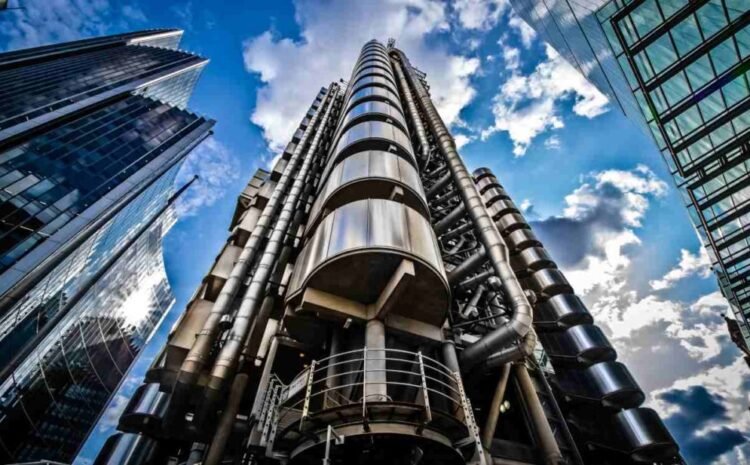
Lloyd’s of London, commonly known simply as Lloyd’s, is an insurance and reinsurance market based in London, United Kingdom. Lloyd’s is not an insurance company in the usual sense of the word, but an insurance marketplace where Lloyd’s members meet. It operates as a partially interchangeable marketplace within which multiple financial sponsors, grouped in syndicates, converge to pool and distribute risk. These underwriters, or “members”, are a collection of both corporations and individuals, usually known traditionally as “names”.
The history of Lloyd’s coffee house
Lloyd’s coffee house was an important meeting place in London during the 17th and 17th centuries. It was founded by Edward Lloyd (1648-1713) on Tower Street in 1686. The coffee house was a popular gathering place for sailors, merchants and ship owners at the time. Edward Lloyd collected and provided reliable ship and sea transport news to his visitors.
This cafe formed a community that was involved in shipbuilding and shipping. Therefore, business people often visited this cafe to discuss issues of marine insurance, ship brokerage and foreign trade, to conclude profitable deals and cooperation agreements. Such deals led to the creation of the insurance market Lloyd’s of London, Lloyd’s Register and several associated transport and insurance companies.
In December 1691, the cafe moved to Lombard Street. There Lloyd set up an indoor tribune where prices were announced at auctions, and lots often included ships and shipping. The latest shipping news was also discussed at the cafe.
In the late 1690s, Edward Lloyd began publishing a newspaper, Lloyd’s News, where he reported on the schedule of ships, insurance contracts and agreements that were concluded in the coffee house.
War could bring prosperity to marine insurers
To get good profits, the businessmen of the 18th century did not hesitate to use any methods and did not experience any remorse. British insurance houses did not hesitate to insure even enemy ships in times of war. In view of this, in 1748, the English Parliament issued a law prohibiting the insurance of French ships and cargo, although the Spanish law did not prohibit insurance. However, even this law met with fierce opposition in Parliament. By this time, the insurance business in London had developed so much that insurers even concluded such deals that were nothing more than gambling.
If the risks are high, then the premiums are too. In addition, the first manifestations of the industrial revolution were already making themselves felt. Exports and imports increased 3 times between 1780 and 1800. And this was also reflected in higher insurance profits. Premiums in the Royal Exchange Assurance also tripled. The Napoleonic Wars led to a boom in marine insurance. The number of insurance brokers has grown substantially. During the war, the number of brokers exceeded 2000. In 1802, a new large hall on the Royal Exchange was rented for the placement of the insurance exchange. The new Lloyd’s has evolved from a small coffee house to a national insurance institute.
Competitors are on the heels
Despite Lloyd’s resistance, the Select Committee initiated the end of his monopoly. In 1824, the highly influential group of the City of London, which included the Rothschild, Gurney and Baring, formed the Alliance Insurance Company. In 1844, there were already 7 marine insurance companies operating in Great Britain.
However, Lloyd’s remained the national institution and focal point for all maritime information, widely disseminating this information to all participants. The Office of the Secretary of the Society received a wealth of information from everywhere, processed and published maritime news and events, mainly in his newspaper Lloyd’s List. Since 1811, the society has had its appointed representatives in all seaports of the world, who regularly collected information on all local incidents and reported to London. There was no shortage of such representatives who were ready to work for free, since they were all interested in obtaining other commercial benefits from participation in such a large-scale enterprise. By 1829, the number of such representatives worldwide reached 350, and this number continued to grow.
World Wars and Insurance
The First World War again generated a great demand for insurance of goods at sea and on land against war risks. The government took over 80% of all maritime risks, becoming the insurer of last resort, but leaving 20% to private companies. As a result, private insurance brokers earned large profits while the government lost £ 7.5m in claims.
During World War II, Americans worried that information about sea movements and objects on the ground, which was used by private insurance brokers, could fall into the hands of the enemy, and this could be important intelligence information. In 1942, the United States banned the transfer of information about the movement of ships or factories involved in the production of military products to private brokers.
Insurance trend
Since the 1950s, the demand for insurance services has evolved in two directions. First, the proliferation of automobiles has generated a new car insurance that has become the most prevalent in many countries. And secondly, in the process of the merger of the industrial and financial world, a huge part of the property ended up in the hands of large global corporations, whose insurance needs were different from those of small companies. Large corporations also had enough of their own resources. Another change has been the shift from direct insurance to reinsurance. Many countries have established their own state insurance with monopoly rights and have banned insurance abroad.
In 1982, Lloyd’s already had 20,145 members, almost nine-tenths of whom were citizens of the British Commonwealth. Foreign members were not accepted until 1969.
Notable Lloyd’s Cases
Many insurers took part in the insurance of the Titanic for 1 million pounds sterling in 1912, the insured amounts varied from 500 to 75,000 pounds with a premium of 0.75%. When the Titanic sank, the damage was distributed among all of this multitude of participants.
Late 1980s: Piper Alpha and the LMX spiral
For a long time, Lloyd’s syndicate reinsured another, but when Piper Alpha, North the Sea oil rig exploded on July 6, 1988, causing an initial loss of $ 1.4 billion. This practice became so widespread that the Lime Street underwriters at first did not even know how large their risks were: losses were reported. As the London Market Loss Excess (LMX) spiral and claims value spiral out of control.
The rig operator, Occidental Petroleum, bought the direct insurance policy from Lloyd’s underwriters, who then passed on some of their exposure to other syndicates through reinsurance. These reinsurers then, in turn, reinsured some of the risk to other reinsurance underwriters within Lloyd’s (known as “retrocessionaries”) and so on. Consequently, many syndicates, especially those that charge large amounts of excess loss reinsurance, have been sued for the same claim multiple times through several levels of the spiral. Other disasters, including Hurricane Hugo and the Exxon Valdez oil spill in 1989, have also spiraled. Some of the leading LMX insurers at the time that suffered serious spiraling losses, including numerous syndicates managed by Gooda Walker, Devonshire 216, Rose Thomson Young 255, RJ Bromley 475, and already disputed syndicates 540 and 542 by Patrick Feltrim Fagan. Syndicate 298 Gooda Walker became the first fatal casualty: only 13,500 policies were impacted by the Piper Alpha disaster, his 1989 bill resulted in a 650% power loss; This was followed by the Feltrim 540 with a loss rate of 550%. Roy Bromley of Syndicate 475 later committed suicide after being fired by his Council and reportedly grieved at the mounting losses of his operations.
Not all loss authors succumbed to the LMX spiral; in fact, the spiral was relatively limited to a minority of such syndicates. Notable reinsurers who were left profitable throughout the spiral included syndicates CF Palmer 314, MH Cockell 269/570 and DP Mann 435, while GS Christensen 958 reported only marginal losses in 1989 but decent profits in 1990 and 1991.