The last few years have been exhilarating and challenging time for an industry that is traditionally risk-averse and slow to change. As we look to 2025 and beyond, insurers must harness the momentum they’ve gained to meet a host of new difficulties. These include macroeconomic and structural headwinds, increased demands regarding climate risk and social purpose, new forms of competition, changes in reporting and accounting standards, and the exponential growth in digital innovation. Regardless of how insurers capitalise on these trends, they’ll need to reassess the future and reimagine their place in the world.
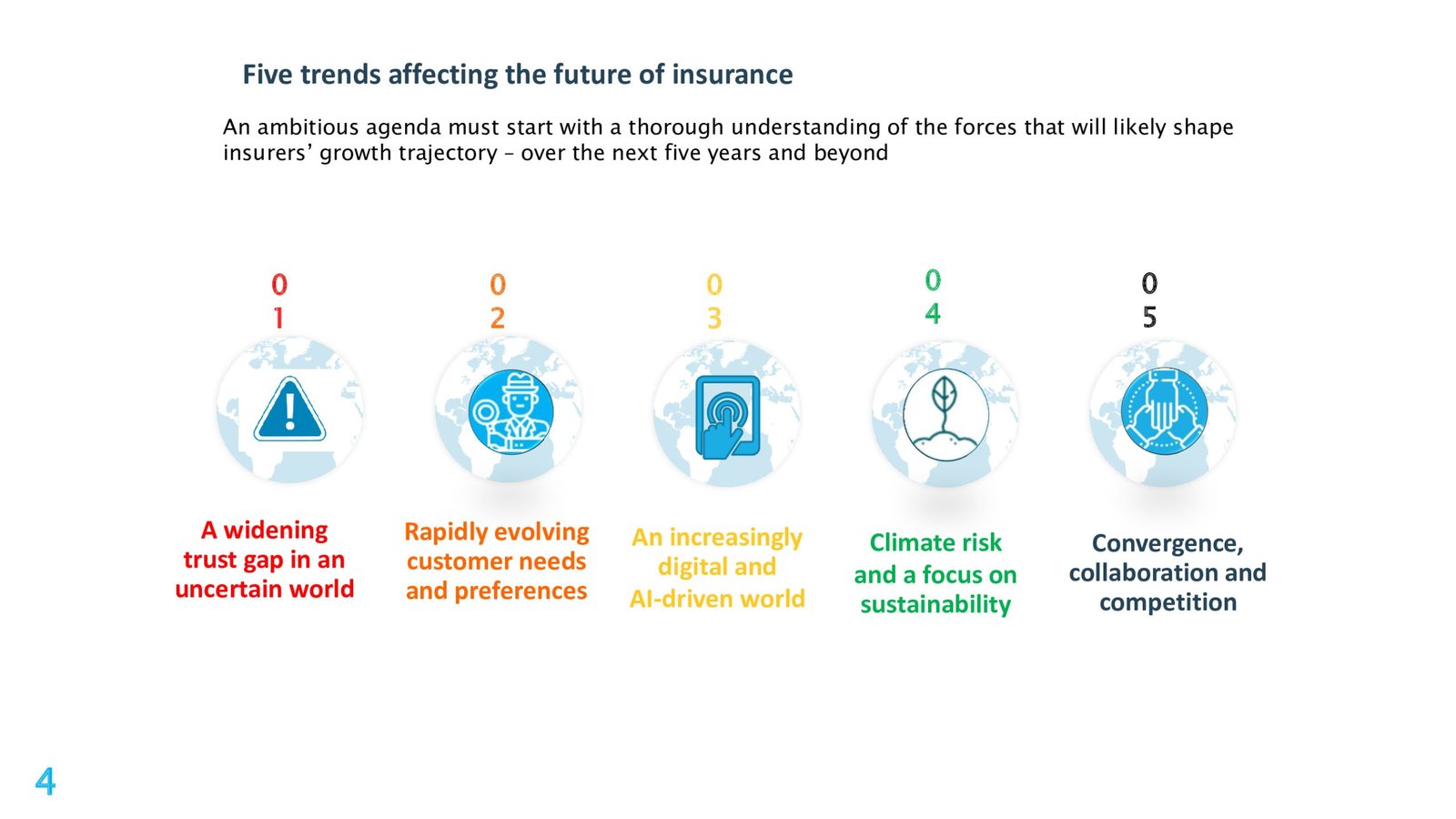
An ambitious agenda must start with a thorough understanding of the forces that will likely shape insurers’ growth trajectory – over the next five years and beyond:
- A widening trust gap in an uncertain world
- Rapidly evolving customer needs and preferences
- An increasingly digital and AI-driven world
- Climate risk and a focus on sustainability
- Convergence, collaboration, and competition
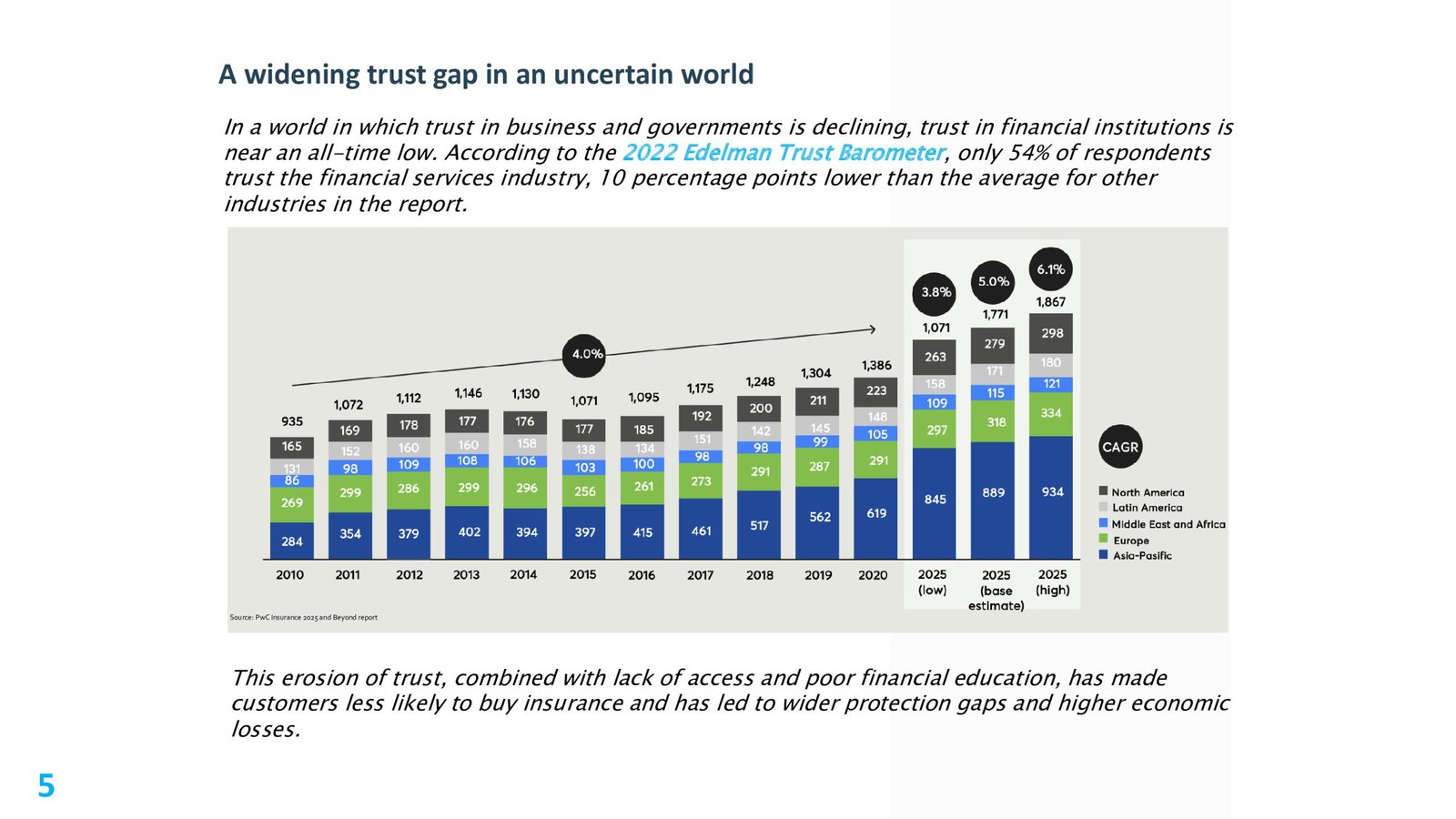
In a world in which trust in business and governments is declining, trust in financial institutions is near an all-time low. According to the 2022 Edelman Trust Barometer, only 54% of respondents trust the financial services industry, 10 percentage points lower than the average for other industries in the report.
Since 2000 the global protection gap (the difference between actual and insured losses) has drastically widened across all sectors, reaching US$1.4tn in 2020. Analysis estimates this gap could reach US$1.86tn by 2025, with Asia-Pacific region accounting for almost half of all uninsured risk. Trust is fundamental for insurance and insurers clearly have a much bigger role to play in our society and economy than just protecting risks. Wealth disparities accelerated by the pandemic and the continued erosion of middle class are some of the factors that have contributed to greater social distrust. To strengthen trust in insurance, some providers are focusing on alleviating social injustice by creating a more inclusive social and business environment. They are working to bridge access and coverage gaps by educating customers, creating affordable products, such as microinsurance, and more effectively distributing them to reach more customers. Some are also forming PPP with government, regulators and policymakers to address financial asymmetries, build solutions for future climate or pandemic related risks, and improve access to affordable healthcare.
Rapidly changing customer needs and preferences
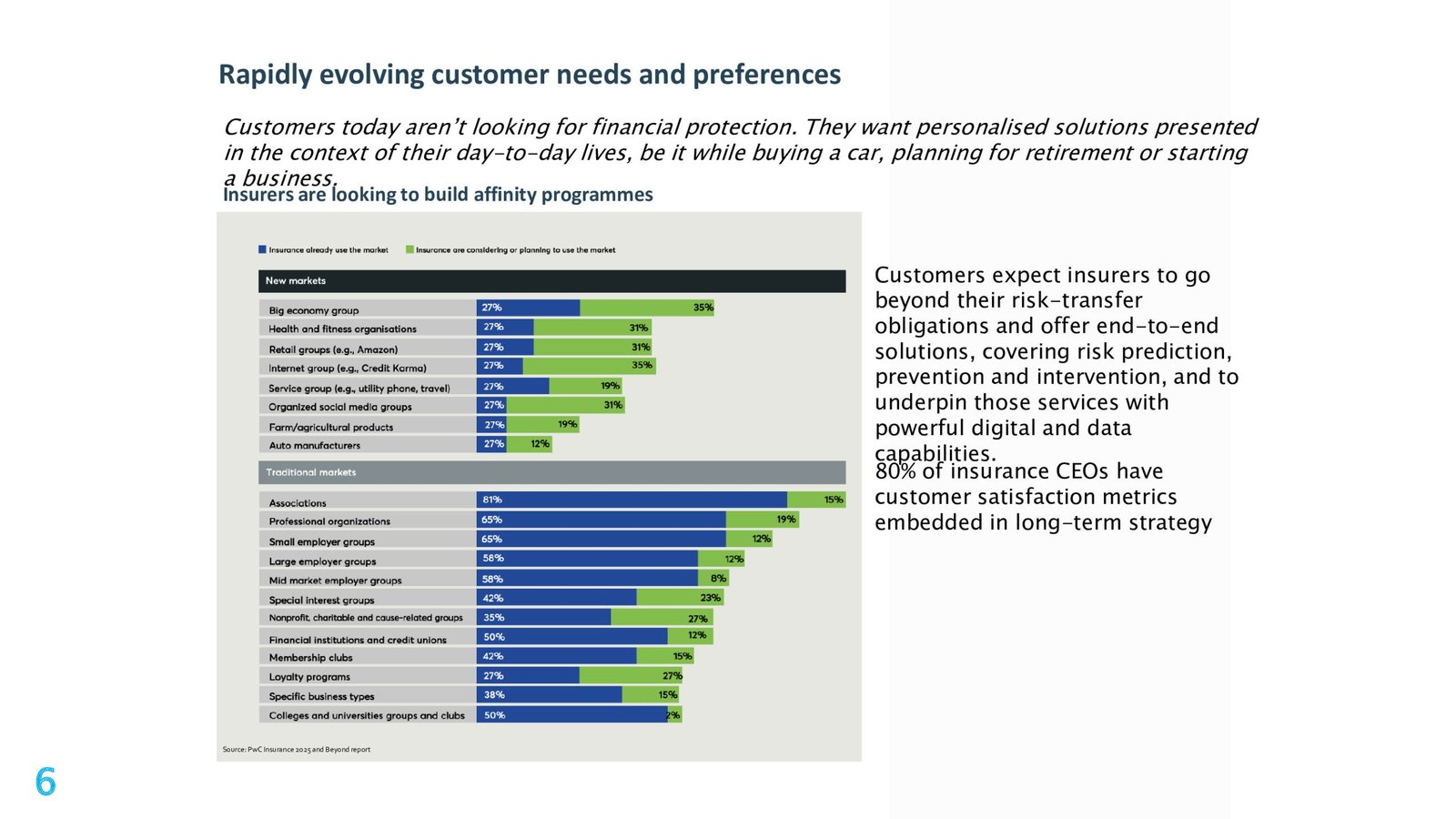
Customers today aren’t looking for financial protection. They want personalised solutions presented in the context of their day-to-day lives, be it while buying a car, planning for retirement or starting a business. Customers expect insurers to go beyond their risk-transfer obligations and offer end-to-end solutions, covering risk prediction, prevention and intervention, and to underpin those services with powerful digital and data capabilities.
To remain competitive, insurers must reimagine how they serve customers, provide advice, and capitalize on new partnerships and innovative engagements in order to create sustainable business models that drive growth and enhance the customer experience. Take for example, the rapid evolution of platform-based business models like marketplaces and embedded insurance. Figure illustrates the growth prospects of affinity programmes and markets that have emerged as insurers seek new partners, such as gig-economy groups and e-tailers, to sell insurance. The demand from consumers is such that we expect a significant portion of insurance revenues will migrate from traditional distribution to digital platforms offering insurance-as-a-service.
An increasingly digital and AI-driven world
Insurance industry is currently in a race to get up to speed with every one of the conceivable outcomes digitization, particularly artificial intelligence brings to the table. AI, is one of the key elements of the digital age and, has disrupted insurance industry as a whole and underwriting risk assessment in particular, and therefore holds future prospects for insurance.
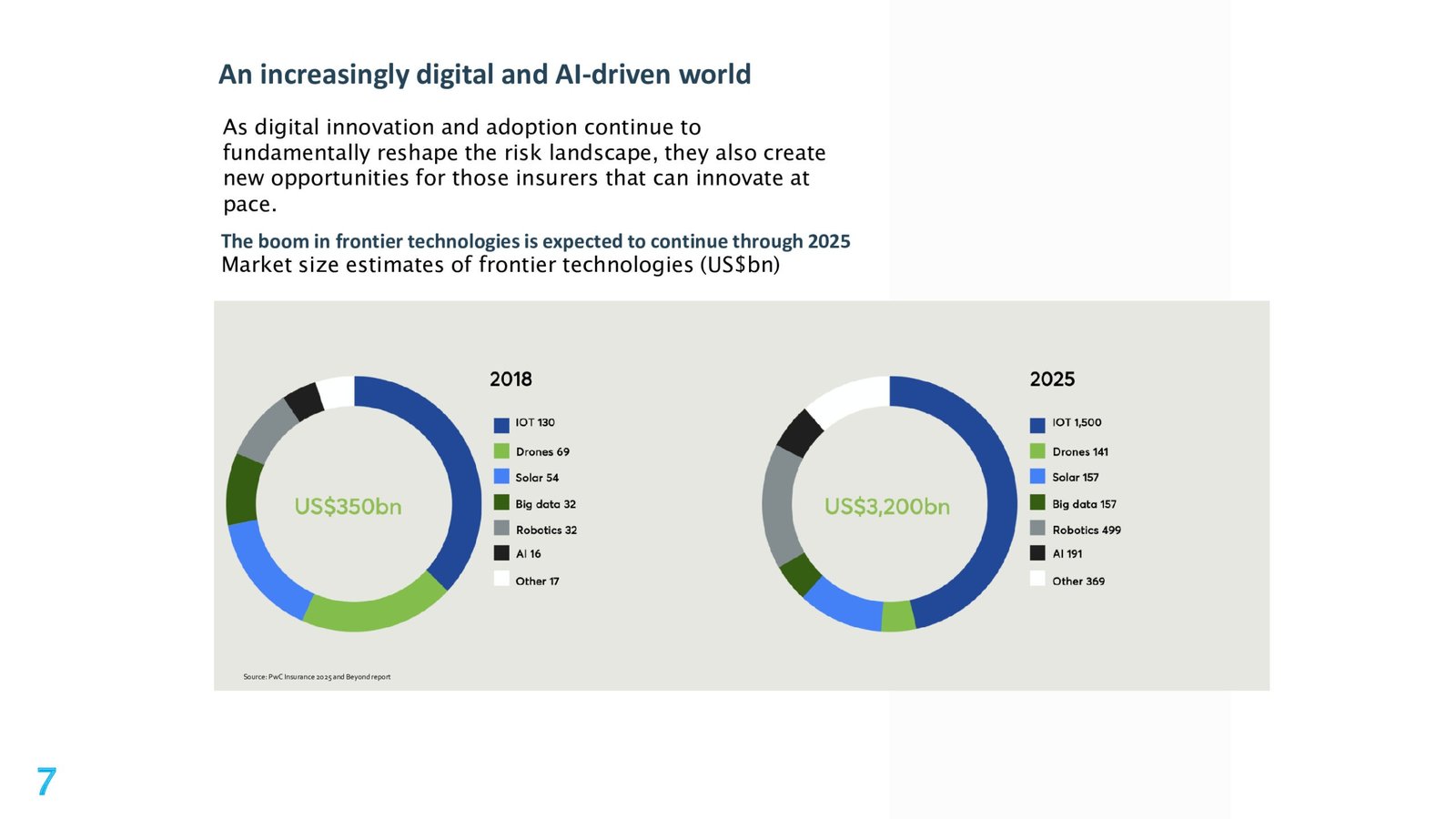
In their 2021 Technology and Innovation report, UN analysts estimated that the size of the frontier technologies market will multiply by a factor of nine by 2025, with innovations in the internet of things (IoT), big data, solar panels and robotics contributing to US$3.2tn
Automation and AI are already changing the way insurers interact with consumers across the value chain – from product design, customer acquisition, engagement, risk management, underwriting to billing and claims – every one of these territories are being changed by the digitization.
With the omnipresence of computers and mobile devices, in any case, the volume of information exhibit on the planet has detonated. And with the widespread ‘Internet of Things’ (IoT) changing into a tangible reality, this quantity will just keep on growing. What’s more, this jumbo ocean of data has rendered established older kinds of assessment outdated. Artificial general intelligence and machine learning algorithms are currently impacting how insurance professionals are assessing risk.
As of not long ago, insurance professionals relied on summed up application forms and simple background checks, bolstered against predefined information sets, to decide premium costs. Though these are still in practice but no longer hold the same value as it used to.
Recent advancements in digitasation of client interactions have included the growing use of so-called bionic advisers that integrate human and digital client experiences. It’s now possible to imagine that a life insurer can predict and intervene in health events based on a simulated digital twin of a customer.
And the industry is edging closer to broader adoption of similar scenarios that can be applied to insurance products across coverage lines, with data inputs from smart home sensors, vehicle telematics data, factory and warehouse sensors, and a growing number of devices with IoT technology.
The insurance sector is continually tormented with stories of fraud cases and AI (artificial intelligence) is the answer for this issue. Machine learning algorithms can observe correlations and trends that are probably going to beat human knowledge and may pass by unnoticed in the risk assessment process. On the far side identifying fake claims, the machine algorithms additionally give an evaluation of the potential liability of the cases and, control and management measures to combat any further deceitful fraudulent claim filings.
Climate risk and emphasis on sustainability
Weather risks are constantly changing and evolving, and we need to understand these changes so that we can price for exposure. To protect against and prevent these risks, insurers will need to develop a deeper understanding of risks, rebuild the risk models and pricing assumptions, create new climate related products and services. Working with industry and government will help drive better standards and make infrastructure more resilient.
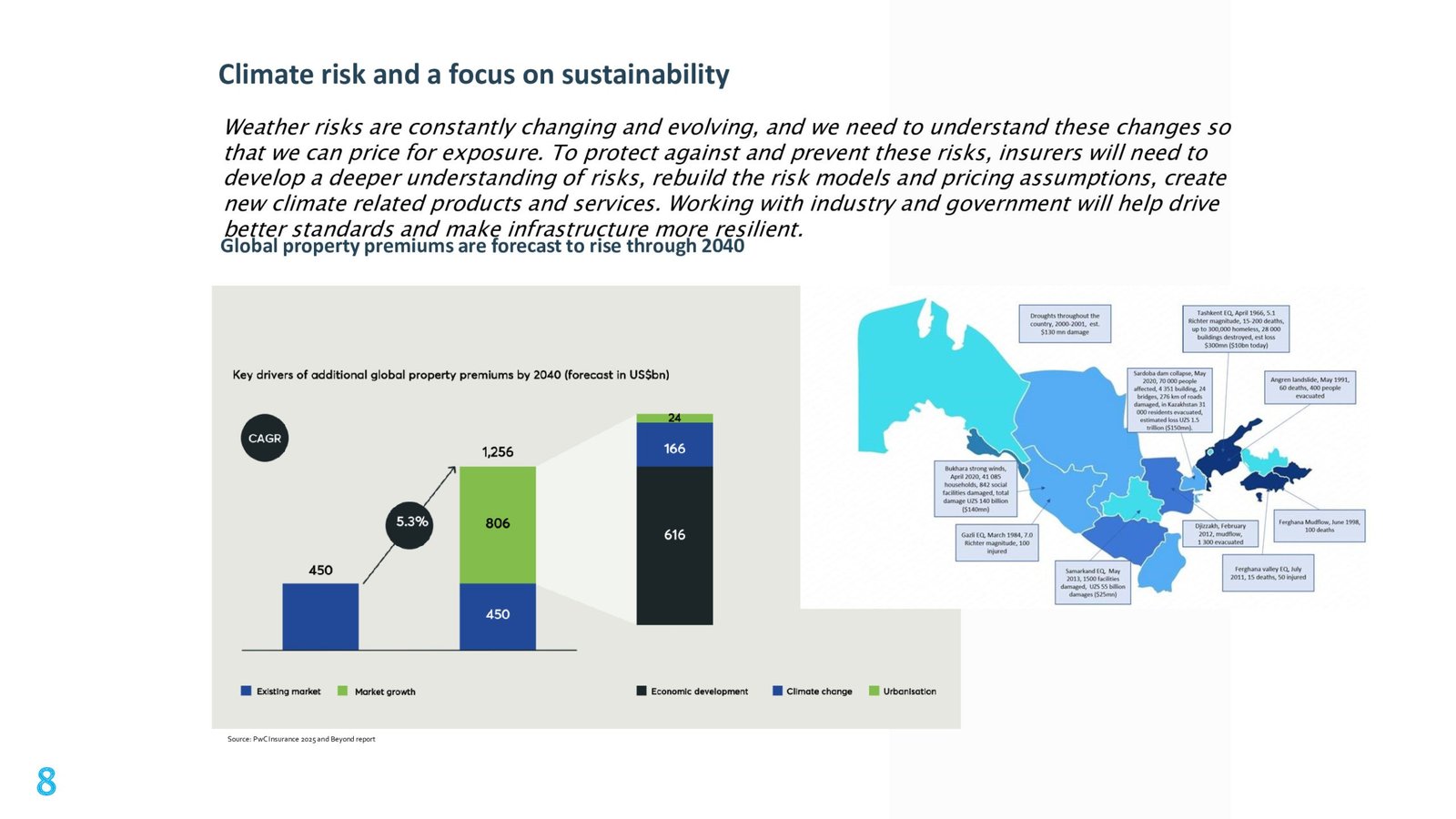
The most recent diaster is a cyclone with a strong wind that hit the Bukhara region on April 27, 2020 with significant damage. 41,085 households and 842 social facilities were damaged. The amount of paid losses to greenhouses alone amounted to UZS 12 billion (appr. $1.2 million). The total amount of material damage amounted to UZS 140 billion (appr. $14 million).
As a result of the breakthrough of the dam of the Sardoba reservoir in the Syrdarya region of the country, more than 70 thousand residents of flooded settlements in three districts of the region suffered. 4351 residential buildings, 24 bridges, 276 kilometers of roads were flooded or damaged. On the Kazakh side, five villages were flooded, over 31 thousand residents were evacuated. 845 residential buildings were flooded. Preliminary estimated losses and expenses amounted UZS 1.5 trillion (appr. $150 million). An overlayed map shows the details of this disaster
It is estimated that the probable maximum losses from earthquakes and flood could be approximately $2 billion on average a year, or 3.5% of GDP (2021). The damages put significant burden on the already stretched government and regional budgets. Due to insufficient funding from all sources, 92.4% of damages caused by earthquakes remain uncovered, and 78.8% – by flood.
The reinsurer Swiss Re estimates that up to US$166bn of premiums could be generated globally by 2040 as a consequence of climate change, mostly in the property insurance segment, given the threat of exposure to catastrophes such as floods, earthquakes, and extreme weather events like storms and wildfires.
Because of their inherent expertise in risk management, insurers and reinsurers have a clear opportunity and societal obligation to lead the way in fighting the global climate crisis. Setting a long-term ambition that’s supported by tangible near-term commitments is the right first step to expand their relevance beyond risk transfer and to take an active role in changing outcomes on a broader scale.
Insurers can work with customers to better adapt to climate change by investing in more resilient infrastructure and supply chains and providing advice to help clients address the physical and transition risks. However, meaningful change will require collective action across the sectors of the industry, including public-private partnerships in which insurers can collaborate with regulators, local governments and policymakers to mitigate climate risk. This sort of collaborative effort can take the form of developing holistic catastrophe risk models, investing in data collection and climate adaptation research, and fostering coherent and consistent climate policies and regulatory frameworks, among other initiatives.
Convergence, Cooperation and Competition
A digital, data-rich economy is allowing organisations to share and collaborate within and across industry boundaries in new ways and create new value propositions for customers. Whether it’s in mobility, financial wellness, health, or SME business needs, much investment is converging around digital platforms such as ecosystems and marketplaces.
To connect with customers in a way that is relevant to them, insurers need to rethink their partnerships and collaborations to go beyond traditional industry and competitive boundaries, and engage in ecosystems in which insurance is only a part of the customer value chain.
Successful business models will drive increased collaboration with traditional competitors, emerging Insurtechs, big tech companies and adjacent industries like manufacturing, retail and healthcare.
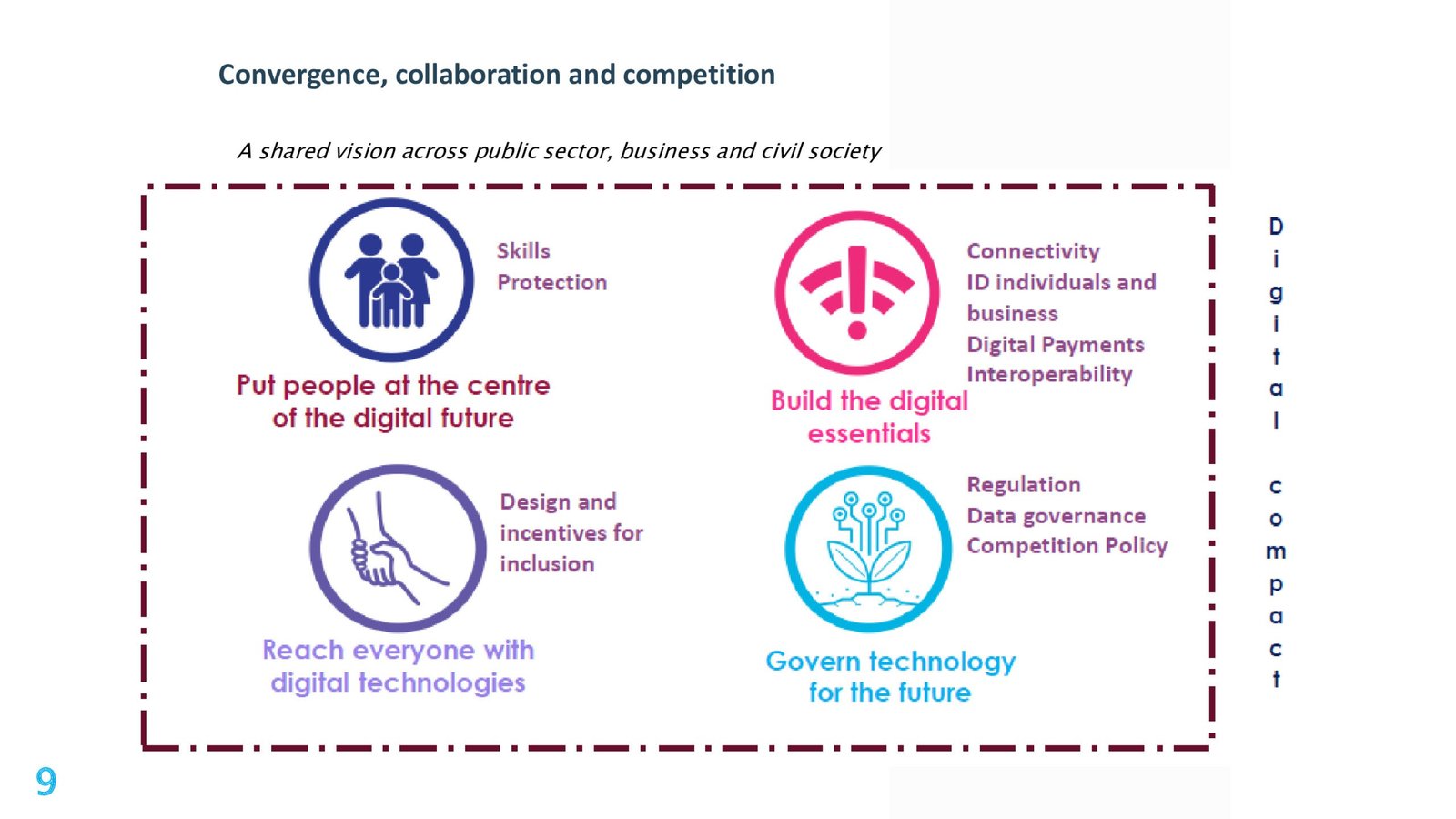
There’s also an expectation that insurers will need to play a larger role in making up for government shortfalls in climate change, elder care and healthcare. Collaboration will be crucial for the industry as it tries to solve for bigger systemic risks through public-private partnerships and build industry-level solutions.
Adaptive ways to reinvent your business
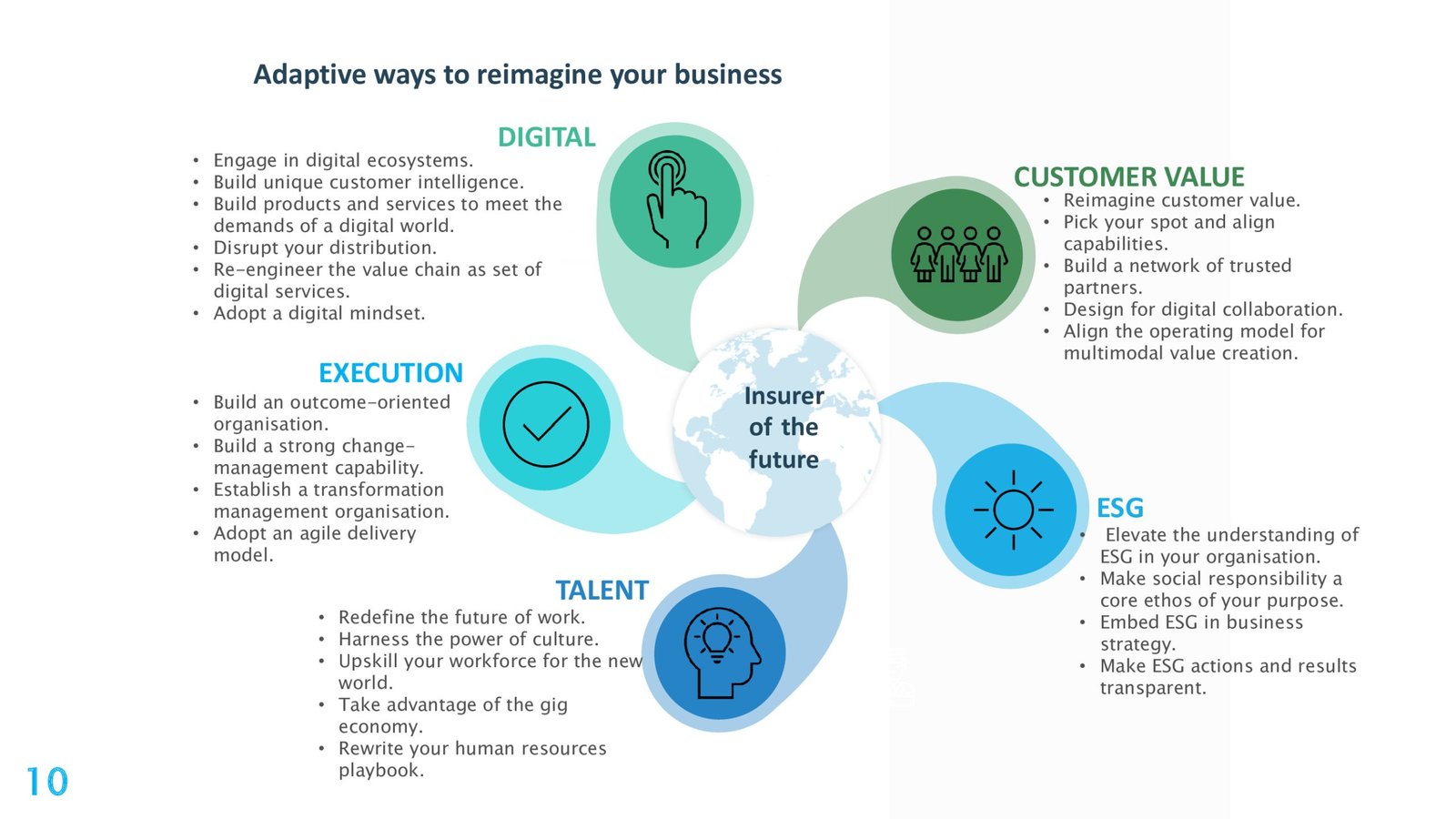
Regardless of how insurers choose to address these trends, they need to envision the future and reimagine their place in the world. After successfully navigating the pandemic’s first two years, now is the time to be bold and create an ambitious agenda. Though the scope of the change is broad and complex, we have defined FIVE interconnected and mutually reinforcing strategic imperatives for all insurance to consider as they embark on their next phase of growth.
DIGITAL – Go on the offensive with digital
- Engage in digital ecosystems.
- Build unique customer intelligence.
- Build products and services to meet the demands of a digital world.
- Disrupt your distribution.
- Re-engineer the value chain as set of digital services.
- Adopt a digital mindset.
– Participate in digital ecosystems.
– Create unique customer information.
Customer intelligence, which acts as the brain of an ecosystem, is created through a seemless sharing of data and and insights across all ecosystem participants. It requires significant investment in upgrading skills and capabilities, along with a cultural shift to a data-driven organisation
– Create products and services that meet the demands of the digital world.
Create new personalised offerings by embracing innovations such as IoT devices, wearables and digital assets. Pay close attention to how the world of digital assets and virtual environments (cryptocurrencies, NFT tokens and the metaverse) are evolving.
– Revisit established sales channels.
Challenge the traditional constructs and constraints of current models, and find alternative ways to reach target customers through cross-industry partnerships, Insurtech alliances and affinity channels
– Transform the value chain into a set of digital services.
Build cloud forward, future-ready architecture, and take advantage of API-based, ‘as-a-service’ technology platforms that allow insurers to offer ‘plug and play’ access to their products and services. Install the modularity, agility and portability needed to integrate with third-party platforms, such as other insurers, distribution partners and Insurtech
– Embrace digital thinking.
Invest in capabilities and culture that truly adopt a digital mindset. We need to modernize our legacy systems and deepen connectivity with our partners.
CUSTOMER VALUE – Embrace customer centric ecosystems to create new value
- Reimagine customer value.
- Pick your spot and align capabilities.
- Build a network of trusted partners.
- Design for digital collaboration.
- Align the operating model for multimodal value creation.
As insurers face an imperative to offer value beyond protection, they need to move faster to a customer-centric risk management model. This entails embedding risk prediction, prevention, intervention, and transfer in the customer journey and making insurance more relevant in customers’ work and lives. Here are some of the critical steps that insurers need to take.
- Rethink customer value.
Reimagine how value is created and delivered to customers who are demanding that insurance be much simpler, more relevant, personalized and accessible. Design products, services and engagement models in collaboration with ecosystem partners to maximize value through the network effect of the ecosystem.
- Choose your place and agree on the possibilities.
Be clear about which ecosystem you want to engage in, what roles you want to play, and where and how in the customer journey you want to engage. Invest in capabilities like offer development, customer analytics, partnership management and customer engagement management that are necessary for mutual success.
- Create a network of trusted partners.
Identify and engage with partners that are aligned in purpose and strategy. For ecosystems to be successful insurers need to invest in understanding and managing those elements that are win-win for all parties and build trust in the system
- Design for digital collaboration.
Build cloud-native API- or microservices based architecture to achieve the agility and flexibility needed to engage in a multiparty ecosystem
“Healthcare is likely to become even more personalized as focus grows on health prevention and behavioral interventions. This will require the integration of clinical data, advice tools, personal health metric tracking, incentives, and health and wellness delivery to extend lifespans and achieve better outcomes in health spans – the time one spends in good health”
- Agree on an operating model for multimodal value creation..
Understand the interplay of capabilities that you’re contributing, receiving from other participants and delivering jointly. Adapt your capabilities and operating model to enable multiparty value exchange, beyond traditional partnerships and alliances, without needing to own or manage all aspects of the model. Establish proper management and governance of the ecosystem without compromising operational agility and speed.
ESG – Embed ESG in your organisations’s core
Incorporate ENVIRONMENTAL, SOCIAL and CORPORATE MANAGEMENT (ESG) into your organization’s core values
Elevate the understanding of ESG in your organisation.
Make social responsibility a core ethos of your purpose.
Embed ESG in business strategy.
Make ESG actions and results transparent.
- Increase your organization’s understanding of ESG.
- Make social responsibility a central tenet of your purpose.
Be authentic about your social purpose. Take a clear stance on key issues, which can include human rights, labor issues, diversity and equality, anti-corruption, supply chain sustainability, and responsible use of digital and AI. As these issues are getting increasingly complex be transparent and consistent about your actions and anchor them in core values.
- Incorporate ESG into your business strategy.
- Make ESG actions and results transparent..
A bolder ESG vision entails having bigger goals and commitments, long-term action that will be reported on a regular basis over time that helps demonstrate companies’ commitment to real lasting change. It’s critical not to miss one of the most important attributes of any successful financial institution in the future: integrating ESG strategy into core capabilities such as investment processes, product innovation, underwriting and workforce management.
TALENT – Win the race for talent
Redefine the future of work.
Harness the power of culture.
Upskill your workforce for the new world.
Take advantage of the gig economy.
Rewrite your human resources playbook
After the pandemic subsides, insurers will need to reimagine their future work and workforce as the wider society navigates changing employee priorities and technology advancements. High demand and short supply of qualified actuaries, underwriters and risk managers combined with disruptions driven by digital adoption make the talent crisis even more pronounced for insurers. Finding creative solutions through flexibility, mobility and upskilling are some of the options that insurers need to explore.
- Revisit the future of work.
Insurer need to fundamentally redefine roles, teams, structures and performance metrics to remain competitive and attract high-quality talent given the increasing adoption of digital and AI, ecosystem-centric business models and a shift towards agile
- Harness the power of culture.
Create a distinctive culture that deliberately connects organisational purpose to the desired cultural norms and values. Winning the race for talent starts with having a culture and a purpose that are attractive. Otherwise, you are bound to be disappointed when it comes to retention. You need to have an appealing mission and a culture that is recognised as strength. By clearly aligning strategic goals with cultural priorities insurers can generate a performance premium.
- Prepare your workforce for a new world.
Shepherd the entire organisation along the digital journey. From your board to the frontline staff, everyone needs to have the appropriate level of familiarity and working knowledge of core digital building blocks like cloud, cybersecurity and AI.
- Take advantage of the gig economy.
Explore alternative sourcing models for finding talent, as finance professionals, actuaries, underwriters and claims handlers increasingly seek independent work with flexibility
- Rewrite your personnel script
Embrace workplace and workforce dynamics of the new world, and redefine employee value propositions focusing on growth, flexibility, diversity and purpose. Align performance management, talent development, progression and compensation to meet the needs of a new generation of employees.
EXECUTION – Put a premium on execution
- Build an outcome-oriented organisation.
- Build a strong change-management capability.
- Establish a transformation management organisation.
- Adopt an agile delivery model.
The fast paced changes affecting the insurance industry are separating the winners from the rest. After strategic rethinking and replanning, what matters next is the ability to execute quickly and drive change at scale. Building transformation and change management as core competencies should be a top priority for senior management.
- Create a results-oriented organization.
Take a lesson from successful private equity firms, and build an outcome-oriented organisations in order to avoid the aspiration-execution gap. Private equity firms prioritize big bets and demand high returns but also put limited restrictions on the resources and investments available to realize those returns. They leverage a talented workforce to get the job done, challenge the accepted norms and barriers, and manage performance with transparent metrics.
- Build strong change management capabilities.
Establish strong leadership at the top with the clear vision and ability to lead the organisation through the change. Ensure sustainable change by devolving leadership intothe ranks.
- Creating a Transformation Management Organization.
Given the scope and complexity of the change involved, often a transformation management organisation led by a senior executive can help bring the right focus, governance and change management disciplines needed to ensure ongoing strategic alignment and increase confidence in realizing desired outcomes
- Use a flexible results model.
Ensure enterprise wide adoption of key agile objectives – speed and outcome – to compete in dynamic environments where customer obsession, cross functional teaming and continues improvements are some of the core ingredients for success.
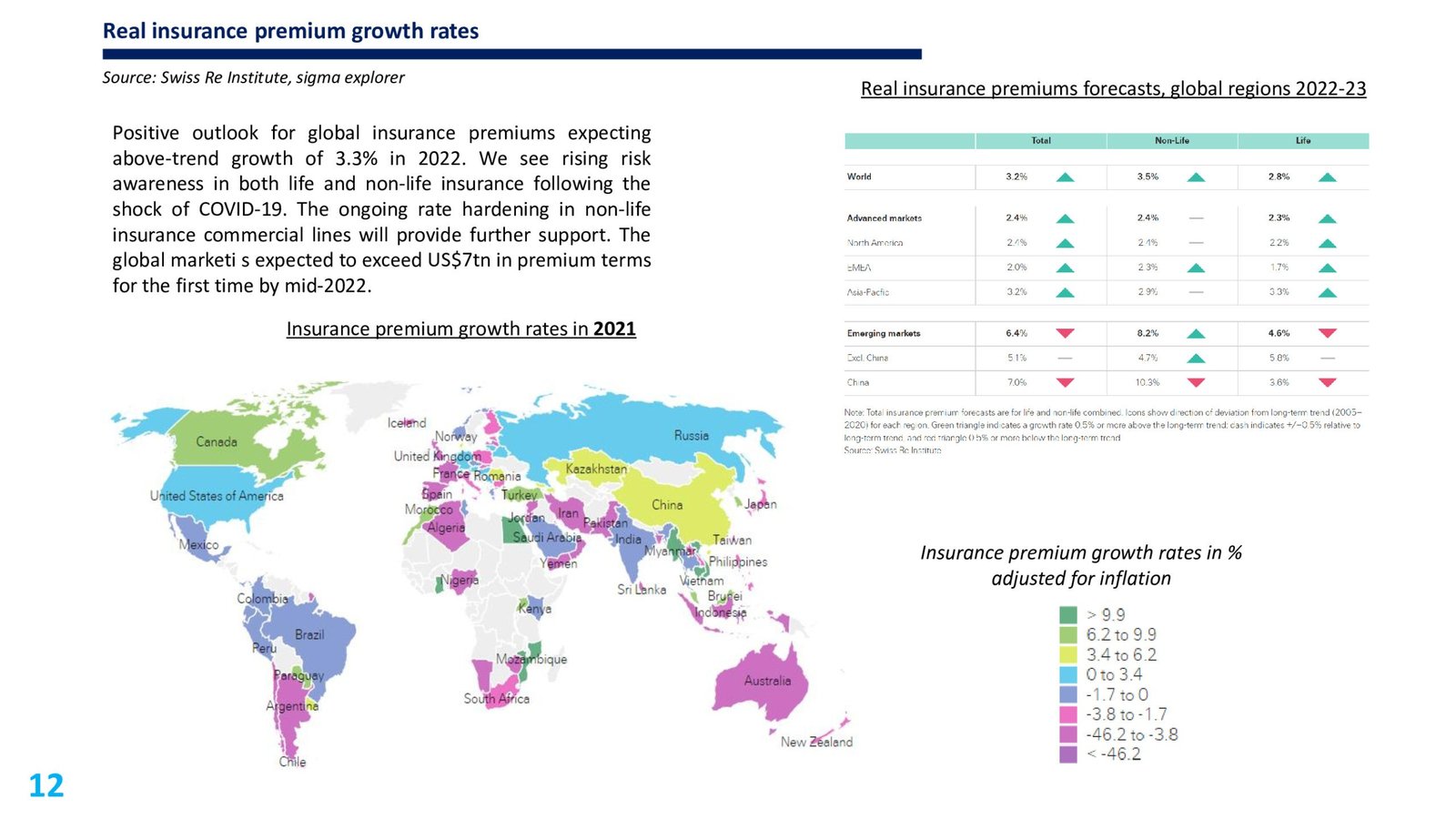
Real growth rate of insurance premiums
Positive outlook for global insurance premiums: 3.3% growth is expected to outpace the trend in 2022. We are seeing increased risk awareness in both life and non-life insurance after the COVID-19 shock. Continued rate increases in commercial lines of insurance other than life insurance will provide additional support. The global market is expected to exceed $7 trillion in premium terms for the first time by mid-2022.
Market conditions suggest that positive pricing dynamics will continue across all lines of business and regions. The main drivers of the tightening market will be inflation-driven increases in payouts in all areas of business, continued social inflation, and persistently low interest rates.
Last year also taught us important lessons. The crisis once again demonstrated the usefulness of the reinsurance industry as a means of taking vital risks; awareness of climate risks increased because of extreme weather events, adding urgency to the race for net-zero emissions. We learned how much consumers welcome digital insurance, and we realized how growing inequality can exacerbate social inflation.
In 2016-2019, insurance premium growth averaged +50%. In 2020, a decrease of 6% due to COVID-19. In 2021, the volume of collected insurance premiums increased by 68.6%, the figure exceeds 3.7 trillion soums.)
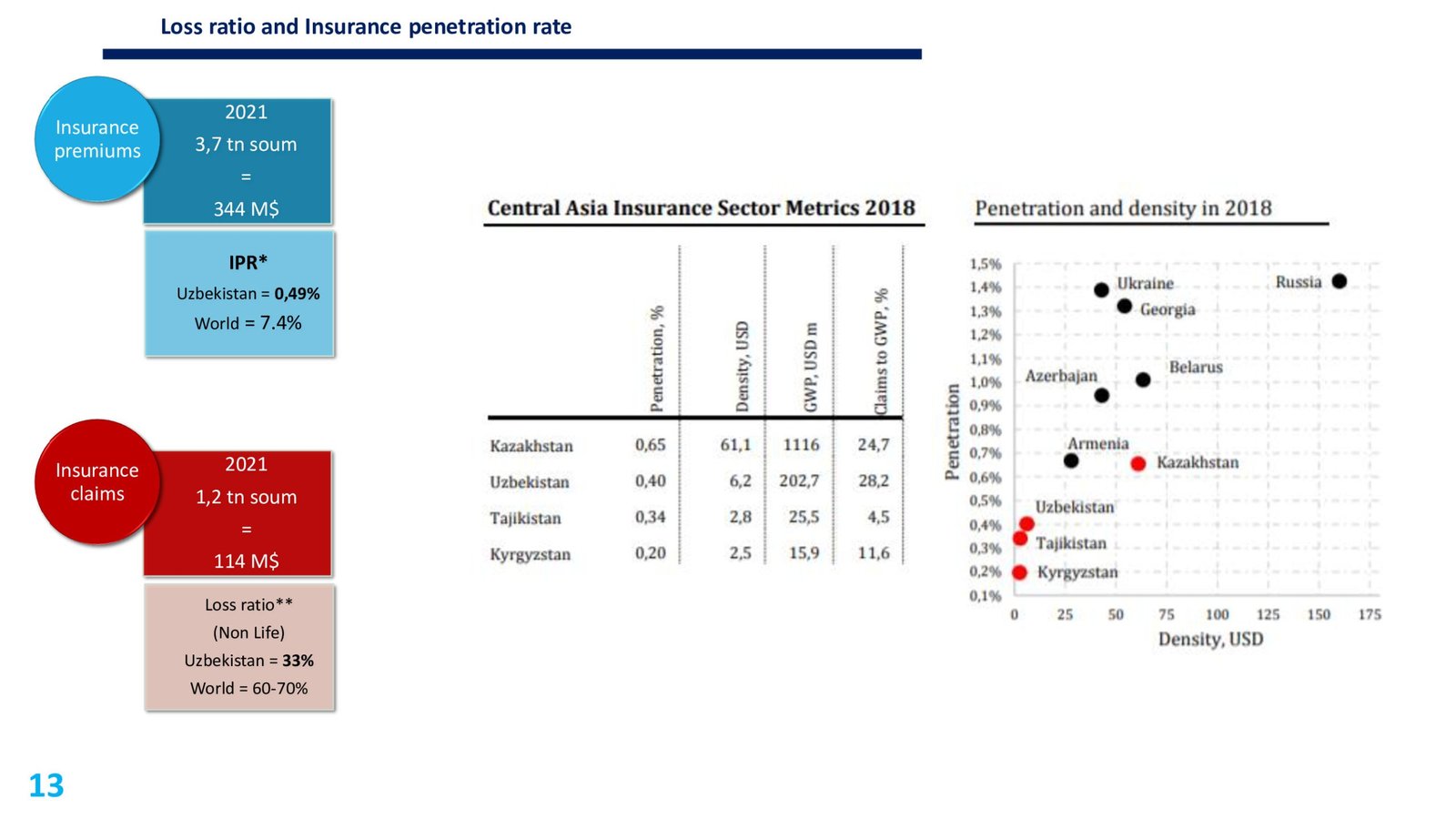
Loss ratio and insurance penetration
Insurance penetration in Uzbekistan is much lower than in other countries.
The volume of insurance premiums in 2021 reached $344 million, which is 0.49% of GDP. The global average IPR is about 7.3%. In Kazakhstan, the figure was as high as 0.7%.
The loss ratio of general insurance is 33%. In the world practice, this indicator averages 60-70%.
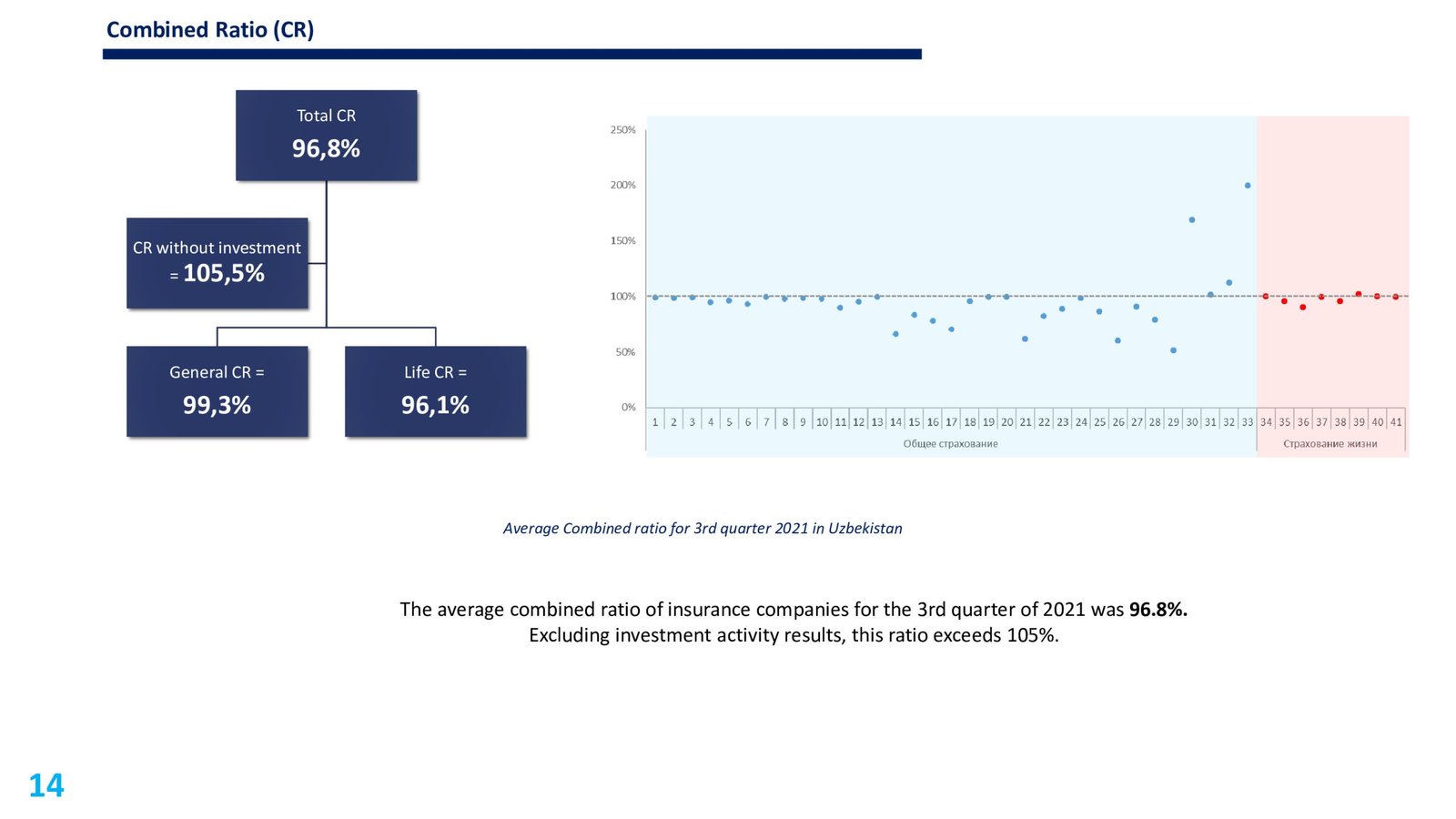
Combined ratio.
The average combined ratio of insurance companies for Q3 2021 was 96.8%.
Excluding results of investment activity this indicator exceeds 105%.
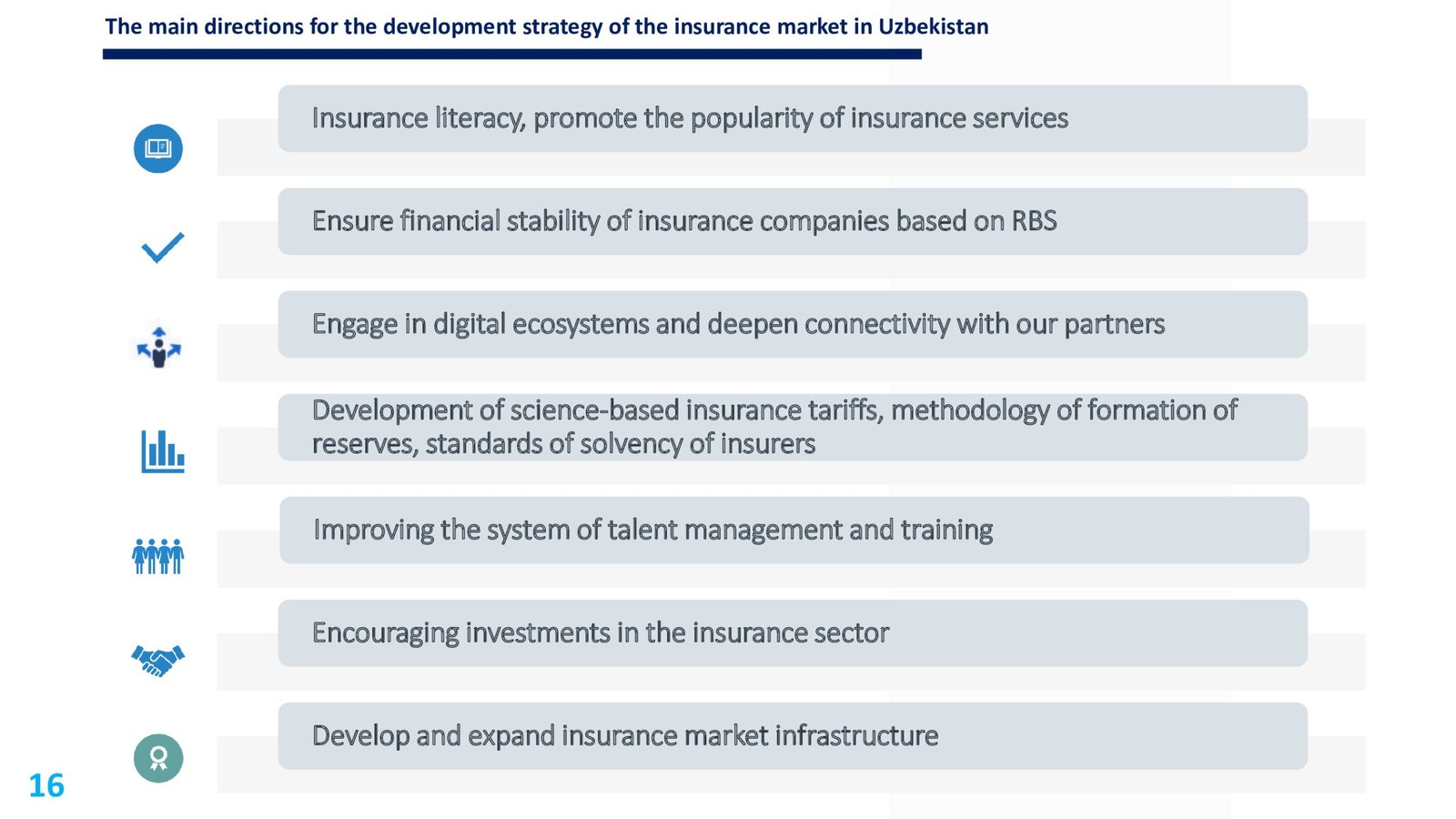
Main directions of insurance market development strategy in Uzbekistan
- Insurance literacy and popularization of insurance services
- Ensuring financial stability of insurance companies on the basis of risk-oriented management
- Participating in digital ecosystems and expanding opportunities to interact with our partners
- Development of scientifically grounded insurance tariffs, methods of forming reserves, norms of insurers’ solvency
- Improvement of talent management and training system
- Stimulation of investment in the insurance sector
- Development and expansion of the insurance market infrastructure